
Choosing a smartphone comes with many options to consider. The most confusing specification of smartphones nowadays is the display type. You will see terms like AMOLED, OLED, Dynamic AMOLED, Super AMOLED and POLED.
There are lots of things to consider when choosing a smartphone. The most confusing specification on smartphones these days is the display type. Terms such as AMOLED, OLED, Dynamic AMOLED, Super AMOLED and POLED can be found:
- Is AMOLED better than OLED?
- Which screen has a better image quality?
- Which one uses less battery life?
- Which display is best for gaming and watching movies ?
Here we will shed some light on AMOLED vs OLED in simple words to help you pick the right smartphone display.
Disclosure: As an Amazon Associate, we earn from qualifying purchases at no additional cost to you.
What is an OLED Display?
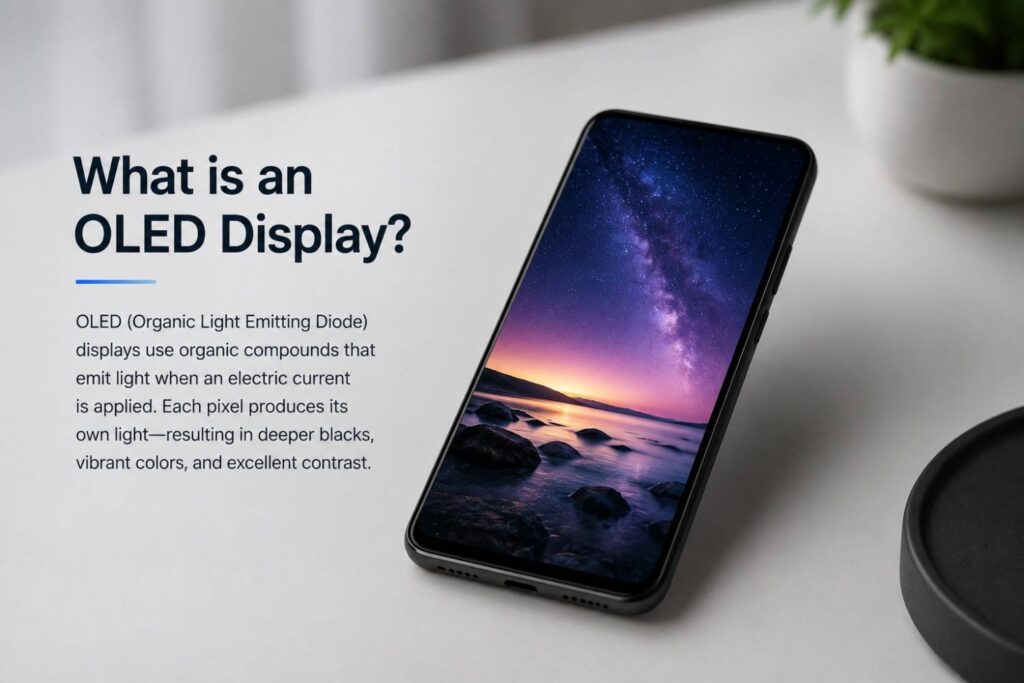
OLED = Organic Light Emitting Diode.
Unlike traditional LCD monitors, OLED screens don’t require a backlight, as each pixel emits its own light.
If you turn off a pixel you get black.
This technology offers:
- Perfect blacks
- Better contrast
- Lower power consumption (in dark mode)
- Thin display panels
- Faster response time
OLED displays are used in:
- Smartphones
- Smartwatches
- TVs
- Laptops
- Foldable devices
What is an AMOLED Display?
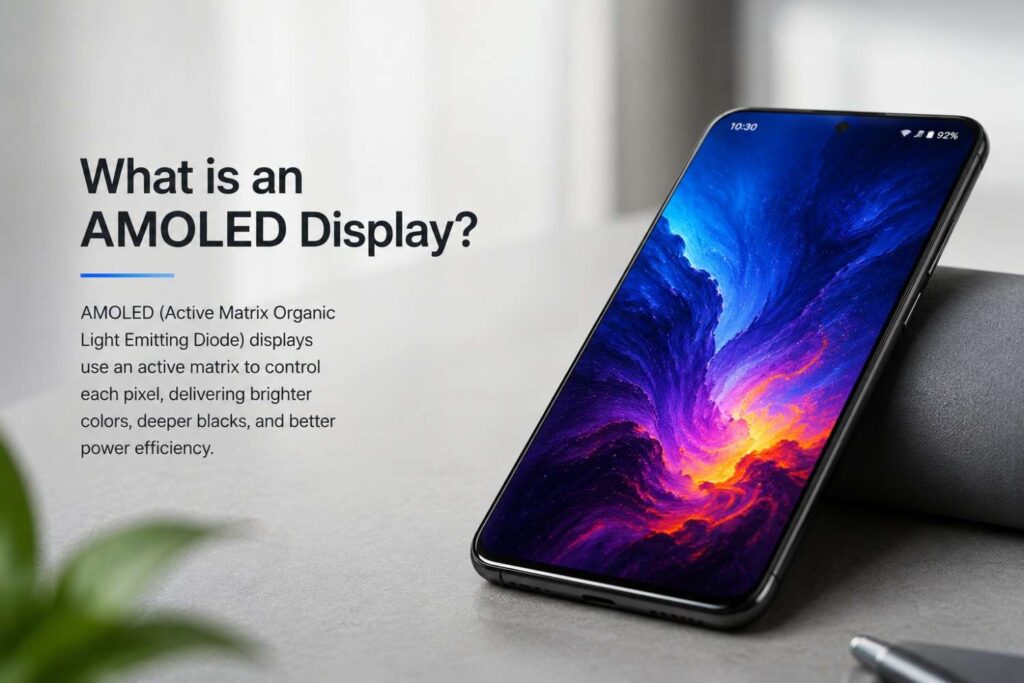
AMOLED Stands for Active Matrix Organic Light-Emitting Diode.
This display is an advanced form of the OLED display.
The only difference is that this display uses Active Matrix technology to control each pixel separately using Thin-Film Transistor (TFT).
This makes AMOLED displays:
- Faster
- More responsive
- Better for gaming
- More power efficient
- More suitable for high refresh rates
AMOLEDs displays are featured in most of the top-end Android smartphones.
AMOLED vs OLED Screen Comparison
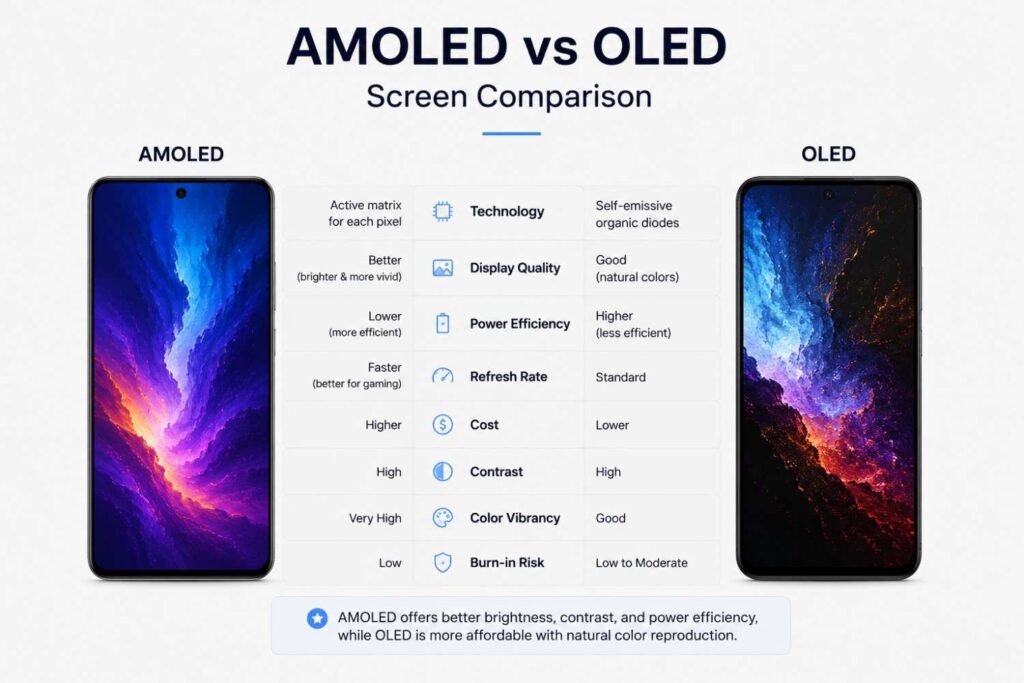
| Feature | OLED | AMOLED |
| Full Form | Organic Light Emitting Diode | Active Matrix Organic Light Emitting Diode |
| Display Quality | Excellent | Excellent |
| Brightness | Good | Better |
| Refresh Rate | Standard | Higher (90Hz, 120Hz, 144Hz) |
| Battery Efficiency | Good | Better |
| Gaming | Good | Excellent |
| Touch Response | Good | Faster |
| Outdoor Visibility | Good | Better |
| Cost | Lower | Slightly Higher |
How Does OLED Work?
The OLED display utilizes organic materials.
When electricity is run through these materials:
- Each pixel lights up independently.
- No backlight is required.
- Individual pixels can turn completely off.
This results in:
- Infinite contrast ratio
- Deep black colors
- Sharp image quality
- Better HDR experience
How Does AMOLED Work?
AMOLED technology utilizes OLED but incorporates the Active Matrix into it.
Every pixel has:
- TFT transistor
- Capacitor
This allows the display to:
- Refresh quickly
- Consume less power
- Display smoother animations
- Support higher refresh rates
It is because of the above reason that flagship smartphones almost always come with AMOLED screens.
AMOLED vs OLED: Display Quality
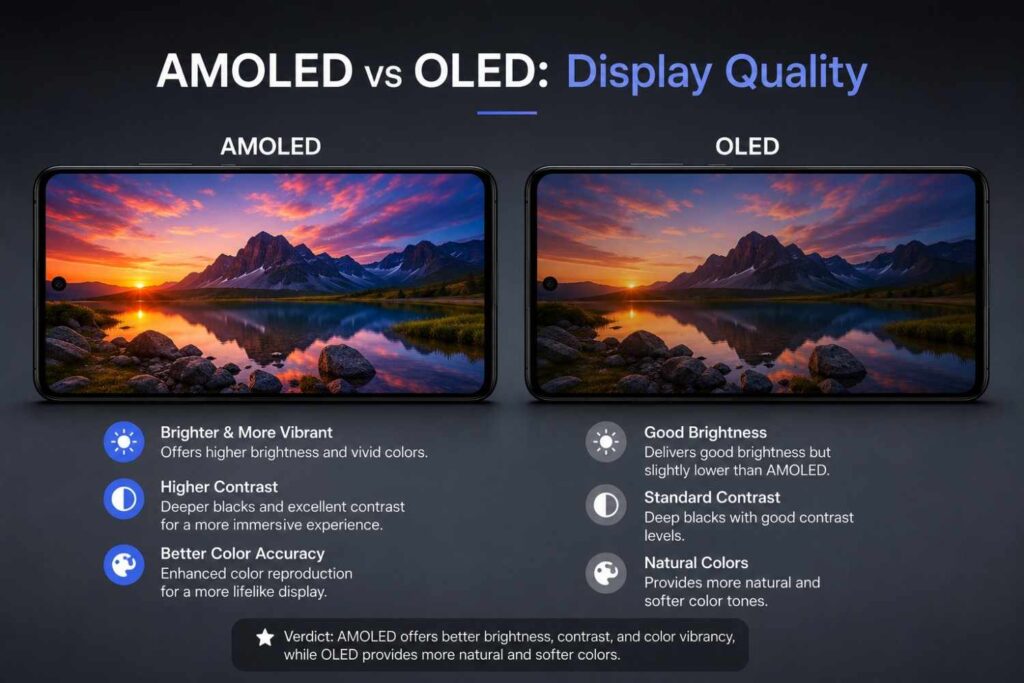
Both displays provide superior picture quality.
However, AMOLED Screen usually delivers:
- More vibrant colors
- Better brightness
- Richer contrast
- Improved HDR support
- Sharper visuals
Want to experience a premium AMOLED display? The Samsung Galaxy S25FE features a vibrant Dynamic AMOLED 2X screen with rich colors, deep blacks, and HDR support. It’s one of the best flagship smartphones available today.
View Samsung Galaxy S25FE on Amazon
Winner: AMOLED
AMOLED vs OLED: Color Accuracy
OLED displays often provide:
- Natural colors
- Accurate tones
AMOLED displays usually produce:
- Saturated colors
- Punchy images
- Better multimedia experience
For creators and photographers:
OLED may look more natural.
For everyday users:
AMOLED feels more attractive.
Winner: Depends on your preference
AMOLED vs OLED: Brightness
Outdoor visibility is extremely important.
AMOLED displays generally offer:
- Higher peak brightness
- Better sunlight readability
- Improved HDR playback
Many flagship AMOLED phones have surpassed 2000–3000 nits in peak brightness.
Winner: AMOLED
AMOLED vs OLED: Battery Life
Both technologies are more power efficient than LCDs, because they can switch off their pixels when showing black colors.
Yet, AMOLED technology is even more power efficient due to its:
- Active Matrix controls pixels efficiently.
- Faster refresh management.
- Better power optimization Display.
Using Dark Mode further improves battery life.
Winner: AMOLED
AMOLED vs OLED: Gaming Performance
Gamers need:
- Smooth refresh rates
- Fast touch response
- Low latency
AMOLED displays support:
- 120Hz refresh rate
- 144Hz refresh rate
- 240Hz touch sampling
- Better motion clarity
For gamers, the OnePlus 13R combines a high-refresh-rate AMOLED display with a powerful Snapdragon chipset to deliver a smooth gaming experience.
Check Price OnePlus 13R on Amazon
Winner: AMOLED
AMOLED vs OLED: Watching Movies
For movies, both displays provide:
- Rich colors
- High contrast
- Deep blacks
AMOLED generally offers:
- Better HDR
- Higher brightness
- Better cinematic experience
Winner: AMOLED
AMOLED vs OLED: Eye Comfort
Both displays can support:
- Blue light reduction
- DC Dimming (on supported devices)
- Reading mode
- Night mode
Yes, some of you might experience PWM flicker in AMOLED display phones at lower brightness.
The modern latest generation of smartphones has fixed this problem to a great extent.
Winner: Tie
AMOLED vs OLED: Durability
OLED panels are known for:
- Thin design
- Flexible construction
AMOLED displays also support:
- Foldable phones
- Curved displays
- Better durability in premium devices
Both technologies can experience:
- Screen burn-in
- Image retention (after prolonged static images)
Winner: Tie
AMOLED vs OLED: Price
OLED displays are generally:
- More affordable
- Common in mid-range devices
AMOLED displays are usually found in:
- Premium smartphones
- Flagship Android phones
Winner: OLED (Value for Money)
Advantages of AMOLED Display
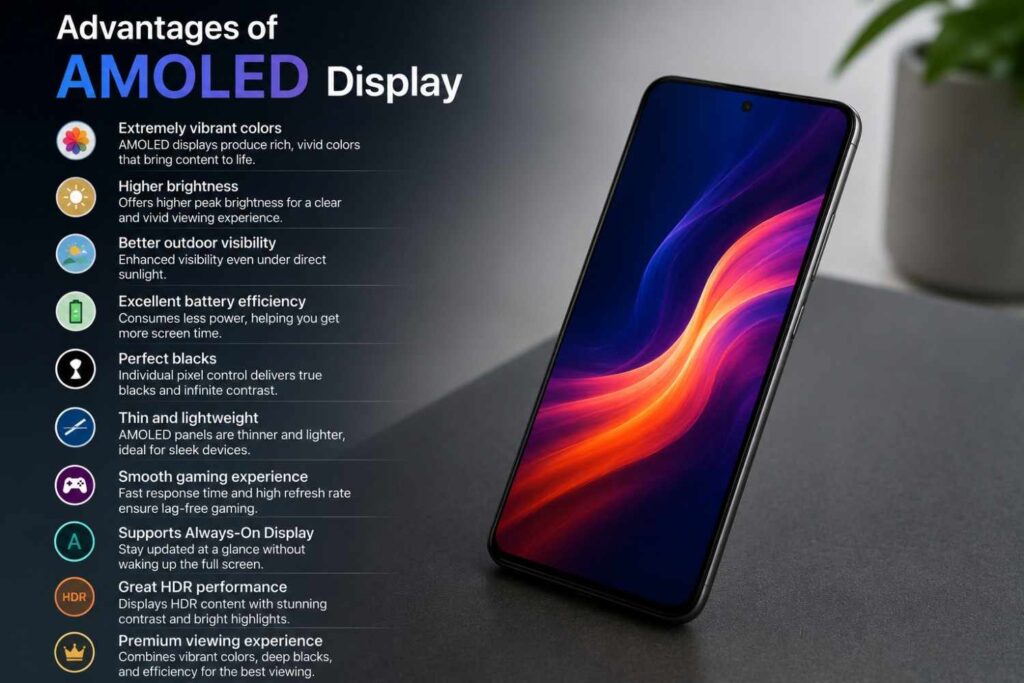
- Extremely vibrant colors
- Higher brightness
- Better outdoor visibility
- Excellent battery efficiency
- Perfect blacks
- Thin and lightweight
- Smooth gaming experience
- Supports Always-On Display
- Great HDR performance
- Premium viewing experience
Disadvantages of AMOLED Display
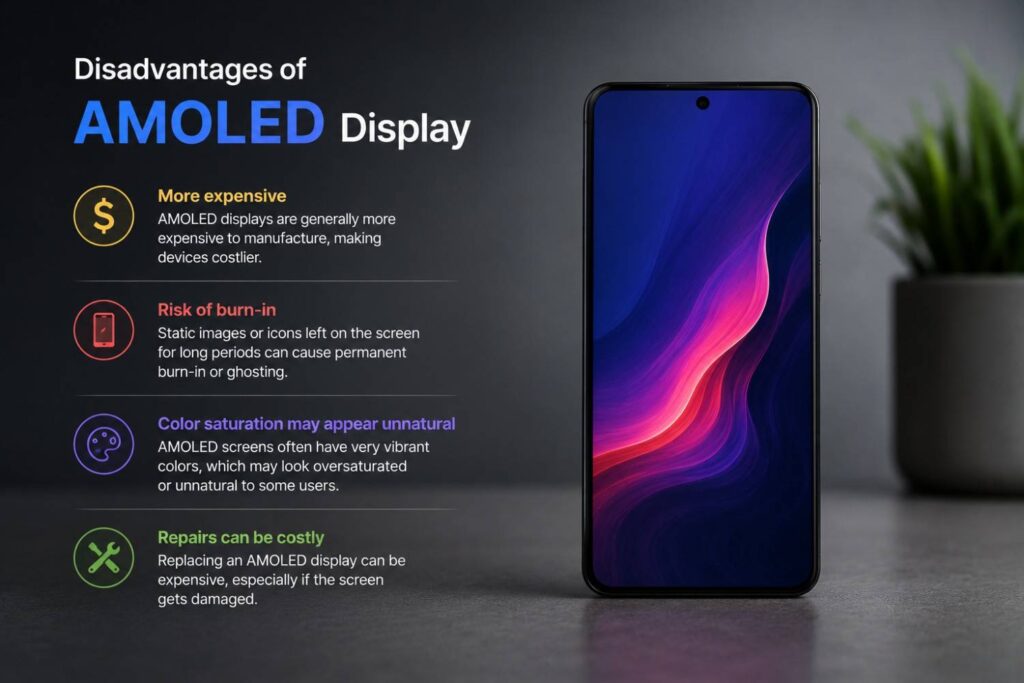
- More expensive
- Risk of burn-in
- Color saturation may appear unnatural
- Repairs can be costly
Advantages of OLED Display
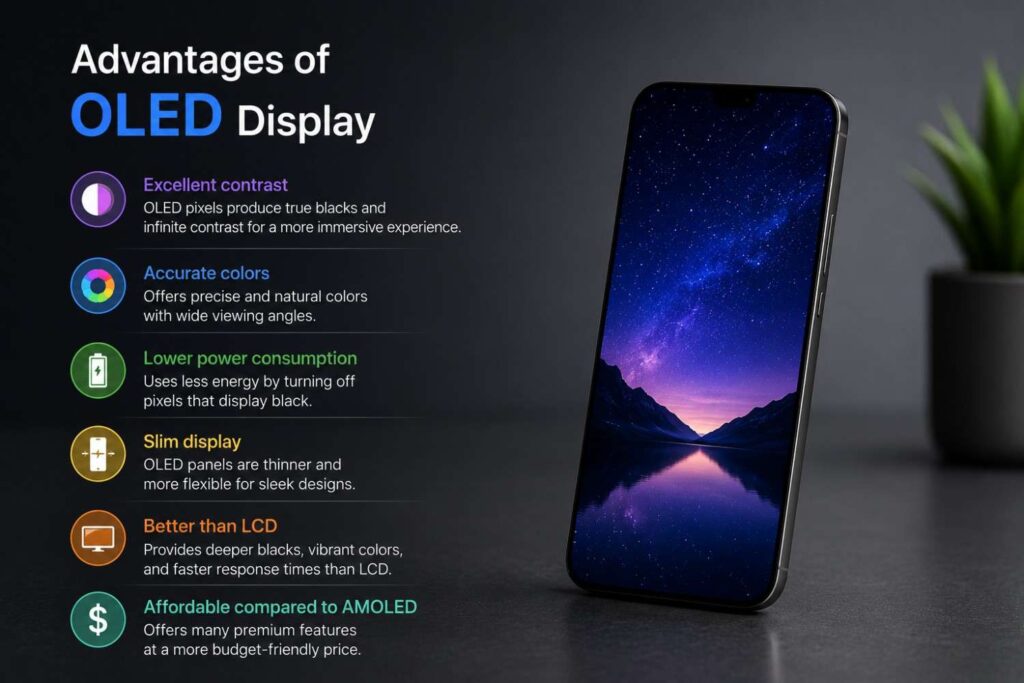
- Excellent contrast
- Accurate colors
- Lower power consumption
- Slim display
- Better than LCD
- Affordable compared to AMOLED
Disadvantages of OLED Display
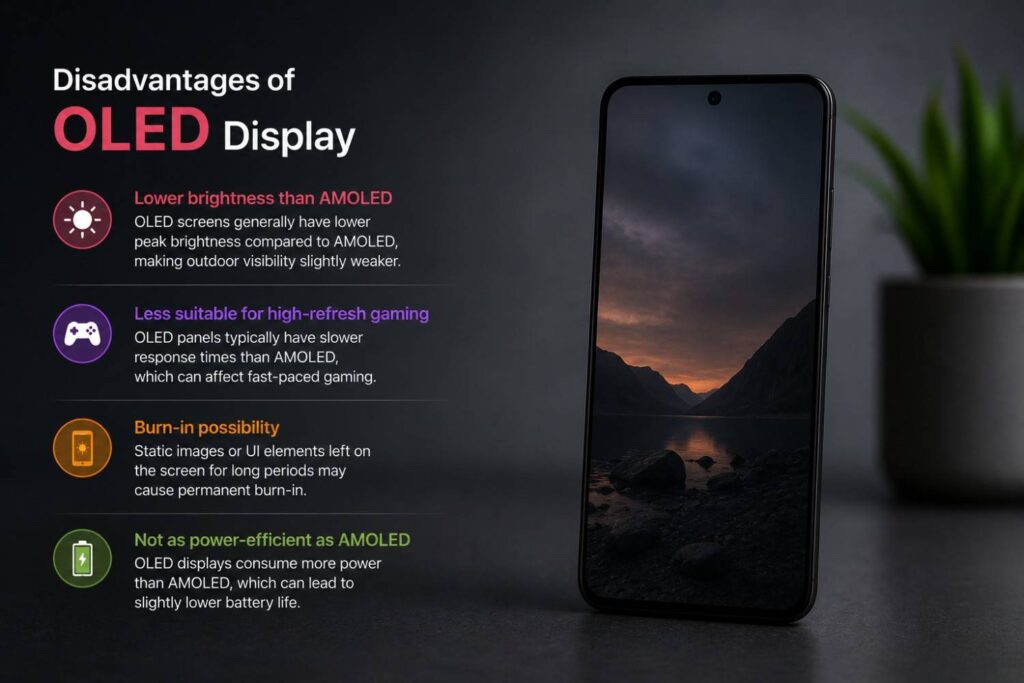
- Lower brightness than AMOLED
- Less suitable for high-refresh gaming
- Burn-in possibility
- Not as power-efficient as AMOLED
AMOLED vs OLED for Gaming
Choose AMOLED if you play:
- BGMI
- PUBG Mobile
- Call of Duty Mobile
- Free Fire MAX
- Genshin Impact
Reasons:
- 120Hz refresh rate
- Fast touch response
- Smooth animations
- Better visibility
Winner: AMOLED
AMOLED vs OLED for Battery Life
Dark Mode benefits both displays.
Battery performance depends on:
- Brightness
- Refresh rate
- Display calibration
AMOLED usually delivers slightly better efficiency.
Winner: AMOLED
AMOLED vs OLED for Daily Use
If you use your phone for:
- YouTube
- Netflix
- Photography
- Social media
Both displays perform exceptionally well.
AMOLED simply offers a more premium visual experience.
Which Smartphones Use AMOLED?
Popular AMOLED phones include:
- Samsung Galaxy S Series
- Samsung Galaxy A Series
- OnePlus smartphones
- Xiaomi flagship phones
- vivo V Series
- OPPO Reno Series
- realme GT Series
- Nothing Phone series
- Motorola Edge Series
Which Smartphones Use OLED?
OLED displays are found in:
- Apple iPhones
- Google Pixel phones
- Sony Xperia
- Motorola devices
- Several premium Android smartphones
AMOLED vs OLED: Which One Should You Buy?
Choose AMOLED if you want:
- Better gaming
- Higher brightness
- Premium viewing
- Longer battery life
- HDR streaming
- Flagship performance
Choose OLED if you want:
- Natural colors
- Excellent display quality
- Good battery life
- A more budget-friendly option
Both OLED and AMOLED are bright screens which give deep blacks, bright images and better energy consumption than classic LCD screens. But, AMOLED takes it a step further by having the active matrix that leads to smoothness, brightness, and responsiveness.
AMOLED is better, especially for gamers, creators and multimedia aficionados, and most smartphone owners. It gives you a great experience with high refresh rate, better battery efficiency and visibility outdoors.
Yet, in case you need an affordable device but want your display to be premium enough, a good quality OLED screen can provide accurate color reproduction and amazing contrast ratio.
Thus, whether you want to buy a flagship phone or a medium range one, knowing the difference between AMOLED and OLED will be beneficial for you.
Frequently Asked Questions for AMOLED and OLED :-
1. Is AMOLED superior to OLED?
Yes, AMOLED screens are considered better due to their quick response time, high brightness, efficiency, and high refresh rates.
2. Which one is best for gaming?
The best display for playing games is AMOLED since it has an ability to provide high refresh rate, low latency and fast response.
3. Does AMOLED save on battery consumption?
Yes. The AMOLED screen is generally much more efficient compared to other screens, especially when the Dark mode is used.
4. Which one gives a better movie experience?
The AMOLED screen provides a better movie viewing experience since it has more brightness, color, and HDR capability.
5. Can OLED and AMOLED displays experience burn-in?
Yes. Screen burn-in is a possible problem with both technologies when the static image is displayed on screen for an extended period.
6. Is AMOLED worth the price difference?
If you need gaming, streaming, bright and clear displays outdoors, AMOLED is certainly worth the cost difference.