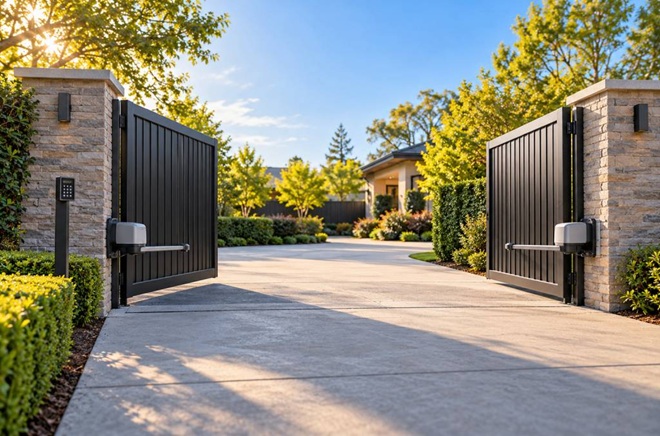
Choose a double-swing gate opener that matches your gate weight, posts, and power supply. Then add safety sensors and the access control you will use. Get these right and your gates open smoothly for years.
A weak motor strains, slows down, and fails early. Then you pay twice. The good news is that you can avoid this. You only need to check a few things before you buy.
Match the Motor to Your Gate Weight and Size
Check the weights of your gates before you purchase. Heavy or long gates require powerful motors, and a too-small opener will fail quickly.
The spec sheet should not be relied upon solely. Often excludes hardware, mesh, and pickets. Use a scale to weigh each leaf, however.
One guide suggests that a 16-foot aluminum leaf weighs approximately 100-180 pounds, and a steel leaf weighs approximately 350-600 pounds. Another guide recommends that the openers be rated at 300 to 800 kg per leaf, depending on the opening size.
Length is also important. For a 16-foot opening, 2 8-foot leaves are recommended for clearances less than 14 feet. There is one additional rule for double gates.
A dual opener is used for two panels; each panel is equipped with a motor, and they both open at the same time. The good news is that there’s room. A double gate will suffice for fireworks displays for narrower driveways; each panel requires half the clearance of a single gate.
Pick the Opener Type That Fits Your Posts and Budget
Choose an articulated arm for an easy retrofit. Use a linear ram to provide a constant power. When appearance is the most important criterion, and the budget is significant, go for an underground system.
Articulated arm motors have a jointed arm on the gate post. They are easy to install and will tolerate minor misalignments.
Openers that operate in a linear movement use a straight arm. In the hydraulic models, pressure is applied; in the screw models, a screw is turned. They are tough and budget-friendly; however, they require accurate alignment.
Underground openers are located below the hinge. They are the most aesthetically pleasing but are very expensive, require drainage planning, and require significant labor and power to install.
One guide quotes swing gate automation prices ranging from $1,500 to more than $4,500. Offers underground systems priced at $5,000-$10,000 or higher.
An articulated arm or a linear opener would be my recommendation for most homes. They provide the optimal balance of price and performance.
Keep Your Gates Moving With the Right Power Setup
If it is all right for you, use mains power. If your property is off-grid, opt for solar. Either way, add a backup battery.
Most openers are powered by the home’s electrical supply and reduce the voltage to a lower level. There are also lights and cameras powered by wired power.
Solar is appropriate for rural properties with limited electrical access. But solar systems require periodic battery maintenance and panel cleaning.
A battery backup ensures that the gates operate even during a power outage. One guide suggests sizing it for at least five cycles. That should get you in and out until the electricity is restored.
Protect Your Family With Smart Safety Features
Never skip safety. Your opener should come to a halt and reverse upon collision. It should also allow opening the gates manually.
Check for obstacle detection with power reverse, manual release during a power outage, slow start and stop, and anti-crush protection. The gate path is monitored by photo-eye sensors. Test them so that the gate stops or reverses within 2 seconds. Test sensors and auto reverse monthly.
Understand the photo-eyes’ range of action. They can be triggered by an animal or snow. A magnetic loop is better for free exit.
Choose Access Control You Will Actually Use
Choose access control that suits your lifestyle. Remotes are great for the family. The keypads are ideal for frequent users. Apps let you open the gates from your phone.
These can be remote controls, keypads, smartphone apps, vehicle loop detectors, and intercom links. Consider adding extras such as smart controls, but only those you need – they add to the cost. Use remotes and a keypad. Then install an intercom if guests come around frequently.
Prepare Your Posts and Ground for a Smooth Install
Prepare posts and ground before the motor arrives. Properly designed posts and hinges keep your opener from being strained.
Check the verticality of hinge posts. The cost of a gate that sinks one inch for every 16 feet is approximately 5 percent of the opener’s load, according to one guide. Also, make sure there is sufficient ground clearance so the gates open easily. Special hardware may be necessary for steep driveways. If you have a steep slope, it can affect the gate’s movement, so be sure to advise your installer early on.
Then, make plans for the little details. Install a “stop” fitting at the center of the driveway to keep the gates closed.
Connect with a cable across the driveway for the second opener as well. Lastly, have a certified installer verify your slope, clearance, and power requirements. A short site visit will save you from expensive errors.
Choose Once and Enjoy Smooth Gates for Years
Weigh your gates. Choose an opener type appropriate for posts and budget. Go for a power source with battery backup. Install safety sensors and only the required access control.
Then, put your posts to the right. Those steps will get your gates open without any hassles. Purchase your gates for the property and not for the salesperson, and you will never be left at the driveway again.