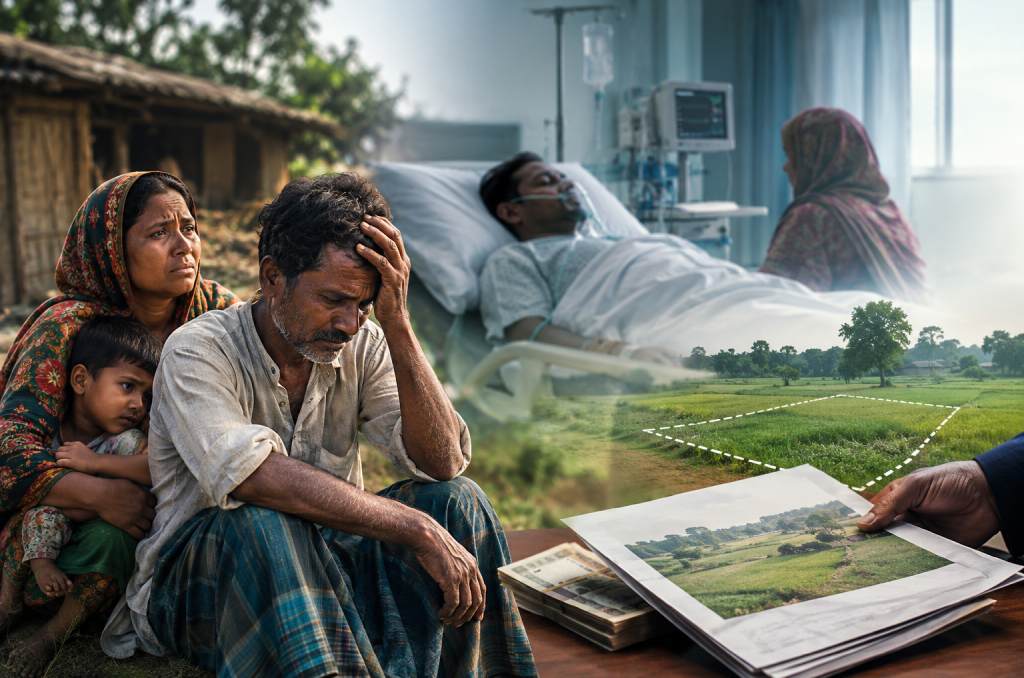
A hospital admission can push a rural family into financial distress because bills arrive fast while income stops and savings run thin. A 2025 national study found that about 61% of hospitalized patients used distress financing, which means borrowing, selling assets, or asking relatives for help. Insurance may reduce eligible costs, but it cannot cover every bill.
A farmer in rural Bangladesh feels healthy on Monday and faces a hospital bill by Friday. The harvest is months away, so the family searches for cash that does not exist.
Many families then borrow, sell assets, or ask relatives for help. This post explains why and what national research shows. It also looks at where affordable microinsurance plans in Bangladesh fit into a broader household protection plan.
Why Can One Hospital Admission Become a Financial Crisis?
One hospital admission can become a financial crisis because treatment costs arrive suddenly while household income may fall.
Out-of-pocket spending refers to money families pay directly for healthcare instead of having those expenses covered by insurance or government funding. Hospital bills can include diagnostic tests, medicines, procedures, and bed charges.
Transport, food and accommodation for accompanying relatives can add to the burden. Meanwhile, patients and caregivers may lose income because they cannot work.
As costs rise and earnings fall, families may have to use savings, borrow money, or sell valuable assets to pay for treatment.
A 2025 Bangladesh study reported an average annual out-of-pocket hospitalization expenditure of USD 418, with cancer-related expenditure averaging USD 2,365.
These figures illustrate the potential financial burden, but their precise interpretation depends on the study’s measurement period and methodology.
Do not present them as the cost of a single hospital admission unless the original research confirms that interpretation.
Why Do Rural Families Have Few Ways to Cover the Bill?
Rural families often have limited savings and rely on seasonal farming or daily wages, making sudden medical bills difficult to manage.
A 2025 Bangladesh study found that patients financed hospital care through savings (32.6%), borrowing (26.78%), help from friends and relatives (18.72%), and asset sales (15.51%).
Regular income covered just 6.39%. These findings show why some families must borrow or sell assets to pay for urgent treatment.
How Can Selling Land Turn an Emergency Into Long-Term Hardship?
Selling land can solve an immediate medical emergency but reduce a family’s future income. A family that sells farmland loses not only the asset but also the potential earnings from future harvests.
Borrowing can add repayment pressure, forcing households to cut essential expenses such as food and education.
For example, a family that sells land for Tk 200,000 to pay a hospital bill may also lose Tk 40,000 in annual earnings.
Over five years, that amounts to Tk 200,000 in forgone income. These figures are illustrative, but they show how a one-time medical expense can create lasting financial hardship.
What Does Bangladesh Research Say About Healthcare Costs?
Research in Bangladesh shows that out-of-pocket healthcare costs place a heavier burden on poorer households and can lead to borrowing or asset sales. Catastrophic health expenditure occurs when healthcare spending consumes a substantial share of a household’s resources.
- Sarker and colleagues (2021): Using national survey data from 2016, researchers found that out-of-pocket healthcare spending accounted for 7.7% of monthly household income overall and up to 35% among poorer groups.
- Datta and colleagues (2018): Analysis of national survey data from 2010 found that households affected by noncommunicable diseases were 85% more likely to sell assets or borrow informally.
- Sarker, Hasan and Islam (2025): Using national survey data from 2022, researchers found that 6.72% of hospitalized patients faced catastrophic health expenditure at the 25% of total consumption threshold. The study also used a 40% non-food consumption threshold.
For a household earning Tk 15,000 a month, healthcare spending equal to 7.7% of income is Tk 1,155, rising to Tk 5,250 at 35%.
The 2025 study also found that rural patients had 1.58 times higher odds of catastrophic spending at the 40% threshold.
These findings highlight the financial risks of healthcare, but they do not prove that a single hospital admission directly causes a family to sell land.
Because the 2025 study examined people who sought care, it may not capture the full burden on households unable to access treatment.
How Can Families Prepare, and Where Does Microinsurance Fit?
Families can prepare by building emergency savings, estimating potential treatment costs, and understanding their insurance coverage. Microinsurance offers affordable protection for specific risks, such as death, disability, or hospitalization, depending on the policy. Hospital cash benefits pay a fixed amount, while reimbursement covers eligible medical expenses.
Before buying a plan, families should check:
- Coverage: Which events and medical expenses are covered?
- Costs and limits: What are the premiums, benefit limits, and waiting periods?
- Exclusions: Which conditions or expenses are not covered?
- Eligibility and claims: Who qualifies, and what documents are required?
Press reports describe Guardian Life’s microinsurance for borrowers as offering life and disability protection and a funeral cash benefit.
These benefits differ from hospitalization coverage, so families should review the written policy terms before enrolling.
Microinsurance can complement savings and family support, but it cannot prevent every financial loss.