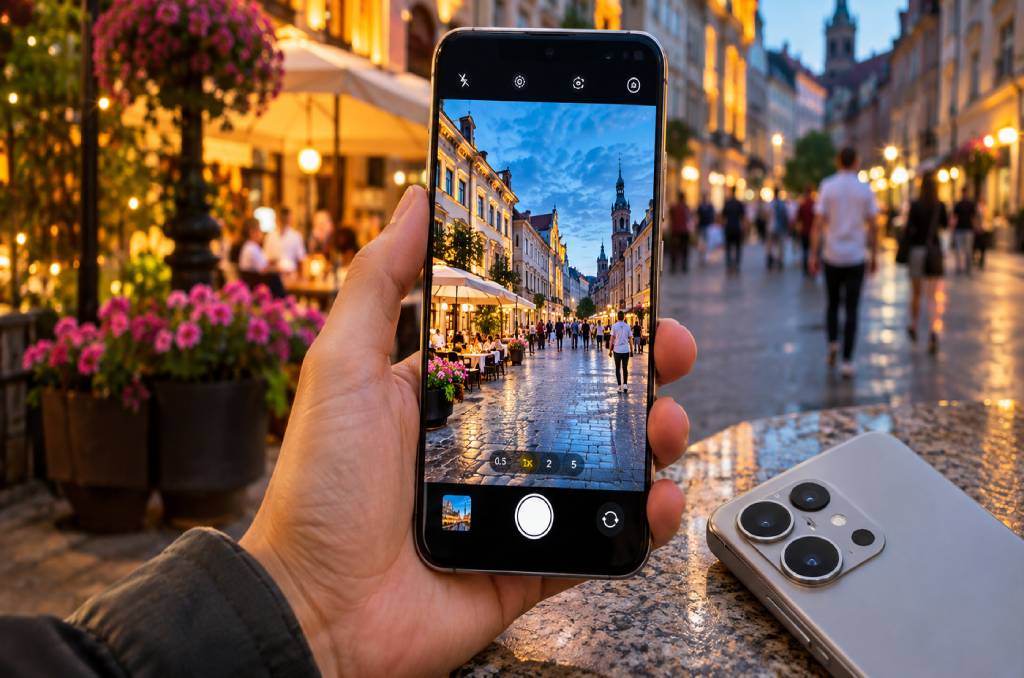
Smartphone camera technology has changed modern photography by putting pro-level tools in everyone’s pocket.
Bigger sensors, multiple lenses, and smart software now handle the hard parts, so anyone can take a sharp photo in seconds.
If you are checking the Oppo mobile price in Bangladesh to find a phone with a strong camera, it helps to know how these changes actually work.
Think about the last time you shot a sunset, a family meal, or a busy street. You tapped once and got a photo that looks great.
Twenty years ago, that took a heavy camera and real skill. This post explains what changed and what it means for your next phone.
The Rise of the Phone Camera
Phone cameras started as tiny add-ons and grew into our main cameras. The first camera phone, the Sharp J-SH04 from 2000, captured about 0.1 megapixels.
Today’s phones shoot at far higher resolution and use software to improve every shot.
The early days were modest. Business Review (Constantin Macri, 2023) reports that Sharp launched the J-SH04 in 2000 with a camera of about 0.1 megapixels.
Progress was fast after that. Penn State News (Amy Milgrub Marshall, 2013) noted that camera phones had been outselling standalone digital cameras for about ten years.
Adobe’s 2021 photography blog adds a clear example. The iPhone 13 had a 12MP camera in 2021, which is ten million more pixels than the first iPhone in 2007.
Resolution was only the start. Better sensors, faster chips, and smarter software did the rest.
Why Megapixels Do Not Tell the Full Story
A higher megapixel count does not guarantee a better photo. Sensor size, aperture, stabilization, and software matter more.
A larger sensor and a wider aperture catch more light, which gives cleaner pictures in dim places.
Many buyers chase big numbers because a 50MP or 108MP label looks impressive. In real use, a bigger sensor and a lower f-number, such as f/1.8, pull in more light. That means cleaner photos indoors and at night.
Pixel binning also helps. A 64MP camera can combine four pixels into one, so it may save a 16MP photo with better detail.
Optical image stabilization (OIS) adds another boost. It reduces hand shake, so handheld shots and videos stay sharp.
Multiple Lenses Gave Phones Real Creative Range
Modern phones carry several lenses, and each one does a different job. Wide lenses handle everyday shots, ultra-wide lenses fit more into the frame, and telephoto lenses bring faraway subjects closer. This mix replaced the need for a bag full of camera lenses.
Phones once had one fixed lens. Now you can switch views with a tap. Optical zoom uses a real lens to magnify a subject without losing quality. Digital zoom only crops the image, so quality drops fast.
This table shows what each common lens type does.
| Lens Type | What It Does | Best For |
| Wide | Main camera with a natural field of view | Everyday shots and group photos |
| Ultra-Wide | Captures a much wider scene | Landscapes, buildings, crowded rooms |
| Telephoto | Zooms in on faraway subjects | Events and street candids |
| Periscope Telephoto | Uses a folded lens for strong zoom in a slim body | Long-distance shots |
| Macro | Focuses very close to a subject | Flowers, insects, small details |
How AI Fixes What Hardware Cannot
Computational photography uses software and AI to improve a photo after you press the shutter.
Night mode, background blur, and smart color correction all rely on it. These tools help small phone sensors compete with much larger cameras.
Night mode takes several exposures in quick order and merges them. The result has less noise and brighter shadows.
Adobe’s 2021 blog says AI already helps with facial recognition and automatic background blur. It also expects AI to adjust white balance and color on its own more often.
Adobe photographer Pei Ketron described how this changed her routine. She once needed a third-party app for clean night shots.
Now she simply switches on night mode. Brands keep pushing further, and Adobe notes that OPPO has experimented with placing the front camera under the phone’s screen.
How Phones Changed Who Takes Photos
Smartphones made photography faster, cheaper, and open to everyone. People now take more photos because there is no film cost and sharing takes seconds. Phones have also turned ordinary people into on-the-spot news photographers.
Penn State photography professor Katarin Parizek explained in 2013 that film once cost money to buy and develop. People thought longer before they pressed the shutter. She also noted that phone photos brought news events to the world within seconds.
Professionals have not disappeared. Business Review (2023) says many photographers now use both phones and dedicated cameras. Their real value is skill, such as lighting and framing, which no filter can replace.
Common Mistakes Buyers Make When Judging Phone Cameras
Most buyers pick a camera phone based on one big number, and that often leads to disappointment.
Avoid the traps below, and you will choose a phone that fits how you shoot.
- Trusting megapixels alone. A 108MP label says little about low-light quality. Sensor size and software matter more.
- Ignoring stabilization. Without OIS, handheld video and night shots can look shaky or blurry.
- Confusing digital zoom with optical zoom. Digital zoom only crops the photo, so a big zoom claim can mislead you.
- Skipping sample photos. Spec sheets cannot show color or noise. Check real photos from independent reviewers.
- Forgetting the front camera. For selfies and video calls, autofocus often matters more than a high megapixel number.
A Simple Checklist for Choosing Your Camera Phone
Match the camera to the way you shoot, then compare the specs that affect real results. A short checklist keeps you focused on what matters.
- List your top use. Decide if you shoot mostly selfies, family events, travel, or video.
- Check the lens setup. The OPPO A38 lists a dual 50MP and 2MP rear camera. The Reno12 F 5G lists a triple rear camera with 50MP, 8MP, and 2MP lenses, plus a 32MP front camera.
- Look for OIS and a wide aperture. Both help in low light and with handheld video.
- Test night mode. Shoot the same dim scene on two phones and compare shadows and noise.
- Compare real photos. Trust sample shots over spec sheets.
Final Thoughts
Smartphone cameras changed photography by making great photos easy. Sensors grew and lenses multiplied.
AI now polishes every shot. Megapixels are only one piece of the puzzle. Choose a phone for the way you shoot, and your next photo will show the difference.